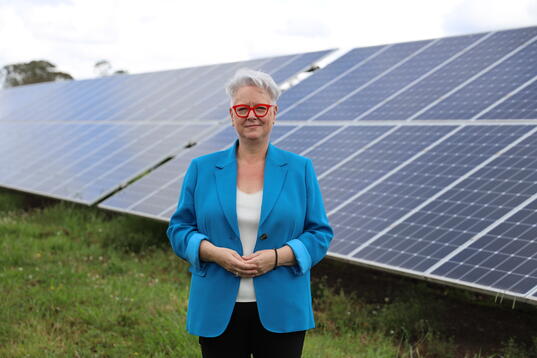
As the most populous state in Australia, New South Wales (NSW) is at the heart of the country’s climate response. We spoke with Penny Sharpe, Minister for Climate Change, Energy and the Environment, about the state’s transition plan, the barriers it faces, and why subnational governments are essential to delivering national and global goals.
What are the main climate challenges in NSW?
We are already living with climate change. Extreme weather is hitting multiple times a year, from floods and droughts to coastal erosion. Australia has already passed 1.5°C of warming, and the costs are mounting.
Disaster recovery spending was AUD 5.1 billion in 2021 and is projected to reach AUD 16 billion annually by 2060. The sooner we act, the cheaper and more effective it will be.
What does NSW’s transition plan look like?
NSW has legislated targets of a 50% emissions reduction by 2030 and 70% by 2035, on the way to net zero. To ensure accountability, we created an independent Net Zero Commission to monitor progress and advise governments.
Their first report shows a projected 46% reduction by 2030 - close but not yet on track. That honesty matters. These goals must outlast any one government and embed climate action across parliaments.
The centrepiece of our work is the energy transition. Fifteen years ago, over 90% of NSW’s power came from coal. Today, renewables supply around 35% and rising. Our Electricity Infrastructure Roadmap manages the exit of ageing coal power while building new generation, storage, firming, and transmission for a cleaner, cheaper, more reliable system.
How does NSW’s plan connect to Australia’s NDC?
If NSW doesn’t succeed, Australia won’t succeed. We account for 26% of national emissions, with heavy industry and high transport demand. Our energy transition alone is critical to national targets.
We work closely with the federal government, but our Commission and legislated targets ensure NSW stays on track regardless of national politics. That is the role of subnational governments: to deliver continuity and ambition from the ground up.
What barriers are you facing?
The first is speed. We often say we’re trying to do the industrial revolution in 15 years. Our planning and regulatory systems were never designed for this pace. That’s why we’re overhauling them and pulling every lever of government we can to speed things up.
The second is community acceptance. While there is broad support for renewables, local opposition to wind and solar projects can be strong. But as a layer of government operating close to the community we are demonstrating how these projects deliver long-term benefits - billions in private investment, regional jobs, and upgrades to roads and infrastructure.
Third, we face inconsistency from global actors. Some multinational companies are stepping back from climate commitments. Our message is clear: stay the course. Prosperity, jobs, and competitiveness depend on it. That is what we are doing.
What makes you most proud so far?
We are moving from talk to delivery. Renewable projects are being approved and built. Pumped hydro and long-duration storage are underway. Farmers tell us renewable projects have drought-proofed their farms and given them steady income.
This gives me hope that the transition has passed the point of no return.
New South Wales is responsible for more than a quarter of Australia’s emissions. Our success isn’t optional, Australia’s climate goals depend on it. With legislated targets, independent oversight, and projects already delivering, we are proving that subnational governments are the engine of national and global climate progress.