

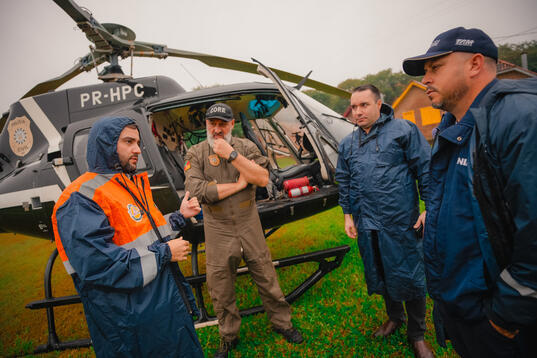
Ahead of the Climate Summit 2025, we sat down with Gabriel Souza, Vice Governor of Rio Grande do Sul, to hear how the state is tackling its most pressing climate challenges and driving forward its Subnational Transition Plan, ProClima2050.
What are the main climate challenges your state is facing?
In 2024 we faced the worst climate disaster in our history: floods that lasted around two weeks and caused almost 200 deaths. Ninety-five percent of our 497 municipalities were affected, with enormous damage to public and private infrastructure.
That tragedy forced us to learn quickly. We are rebuilding roads and bridges with more resilience, have strengthened emergency coordination, and created shelters. But in 2025 we have faced both extremes: a severe drought that hit agriculture, the backbone of our economy, and renewed rains that reminded communities of last year’s trauma.
Tell us about your Subnational Transition Plan.
Our plan is called ProClima2050. It sets long-term goals for greenhouse gas reduction, adaptation, and resilience. This is not just about government action. We are working with the private sector, municipalities, and civil society to reduce emissions and build resilience together.
Almost all our municipalities have now created local climate commissions and report data into a state-level roadmap. We also introduced an MRV (Monitoring, Reporting and Verification) platform that tracks progress across 497 municipalities, embedding a culture of evidence-based policymaking.
How does ProClima2050 connect to Brazil’s NDC?
Brazil is a federal republic - responsibility for the environment is shared between federal, state and municipal governments. Without strong state action, national targets cannot succeed.
In Rio Grande do Sul, we are creating new policies to contribute. One example is a programme to pay farmers who protect the environment on their land. In this first step we are investing around one million US dollars, focusing on rice producers who are reducing emissions while maintaining production
We also created a scientific bureau, bringing together specialists in hydrology, meteorology, engineering and biology, to make sure our decisions are guided by evidence and science.
What we need now is recognition of these subnational efforts, more cooperation to avoid overlaps and gaps between levels of government, and direct access to national and international climate finance at the scale of the challenge. States and municipalities are on the front line - closer to farmers and communities than the federal government - and they must have visibility in global forums.
What barriers do you face in implementing your plan, and how are you addressing them?
Two major barriers stand out: finance and data.
Protecting the environment and building resilience costs money. We need direct access to finance from international funds and multilateral development banks. Without this, we cannot mobilise action at the scale the challenge demands.
On data, the challenge is the sharing of information across ministries, municipalities, and with the federal government. To address this, we created the Unique Map of Rio Grande do Sul, which cross-references multiple datasets to deliver faster solutions. For example, during the floods we used satellite imagery to identify affected households and cross-check with social assistance data. This allowed us to deliver emergency social payments to families within 15 days. This shows how powerful data can be.
Looking ahead, what difference will ProClima2050 make for citizens and communities?
Climate change is happening now, and our citizens are already living its consequences. ProClima2050 is about building resilience - ensuring safer infrastructure, protecting livelihoods, and preparing our economy for a low-carbon future.
Our work is also about sharing lessons. At COP30 in Belém, we will exchange experiences with other subnational governments in Brazil and worldwide. International recognition of subnational action is essential.
The future begins today. If we delay, the cost to people’s lives and livelihoods will be far greater.
More on
SOUTH AMERICA