





Our work in South Korea
South Korea is cited by RE100 members as one of the most challenging market in which to buy renewable electricity, with over a third of RE100 members working in the country highlighting issues. Over 30 Korean headquartered companies are RE100 members, and over 180 international members report operations in the country.
South Korea has has a 2050 net zero target, yet wind and solar accounted for just 6% of South Korea’s electricity generation in 2024.
RE100 members source only 12% of their electricity from renewables in South Korea, compared to 53% for RE100 member electricity use globally. Corporates cite the lack of procurement options, the high cost and limited supply of renewables as significant barriers.
RE100's policy recommendations for South Korea
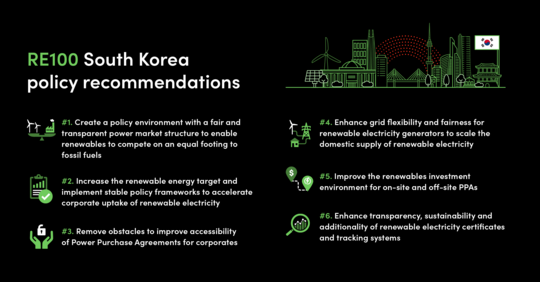
Our policy advocacy work in South Korea seeks to change this, and we've set out six policy recommendations for the Korean government. Launched in 2023, these recommendations are designed to remove barriers to renewables, help mobilise domestic and international private investment in renewables and enable Korea to seize the opportunities of the energy transition. Korean version available here.
Recent policy updates
- President of South Korea, Lee Jae-myung, referenced the importance of RE100 in his inaugural address to the nation in June 2025. Climate Group’s CEO, Helen Clarkson, wrote to the President to welcome him to office and recommended increasing Korea’s 2030 renewables target to 33%, investing in the grid and guaranteeing access for renewable generators, and improving Power Purchase Agreement (PPA) frameworks in Korea.
-
RE100, in partnership with Global Renewables Alliance, sent a joint letter to the Korean government during the Clean Energy Ministerial held in Busan in August 2025. The letter urged increased ambition on renewables in Korea as a leader in Asia Pacific, and was accompanied by a half page advert taken out in the national financial newspaper, The MK, which read "Energy Security = Renewable Energy." RE100 also held meetings with government departments in Korea to discuss the letter and our South Korea Policy Recommendations.
-
In August 2025, RE100 and our local partner, Korea Sustainability Investing Forum (KoSIF), held a roundtable in Seoul focussed on Virtual Power Purchase Agreements (VPPAs). The roundtable offered participating RE100 members the opportunity to enhance their understanding of the structure of a VPPA, and to learn more about corporate renewable energy procurement strategy.
Previous policy successes
- RE100 has become a byword for renewable electricity in Asia-Pacific, especially in South Korea, where parliamentary records show RE100 mentioned on a more than weekly basis. In March 2024, RE100 reported that our members make up 10% of South Korea’s total annual electricity demand, this news and our localised policy messages were published in national Korean news outlets.
- Representatives from South Korea’s National Assembly attended Climate Week NYC in September 2024 to engage in discussions about corporate procurement of renewables with RE100. At the meeting, there was a strong interest and willingness for climate action and we look forward to continuing our conversations with the National Assembly on ambitious policies that will drive South Korea toward a more sustainable future.
- In May 2024, RE100 hosted the Asia Renewables Growth Forum in Seoul, where speakers from large international companies, Climate Group, and representatives from the Korean government discussed Korea’s renewable future.
- The Korean Carbon Neutrality and Green Growth Plan, released in March 2023, included language directly replicating that used in the RE100 South Korea Localised Policy Messages.
- In January 2023, the Korean government took action on Power Purchase Agreements (PPAs), addressing cost issues related to 'double charging', a change RE100 had long advocated for.
In South Korea, we work in collaboration with our local partner Korea Sustainability Investing Forum (KoSIF).
To speak to the team about getting involved in our policy work in South Korea, please contact us.