



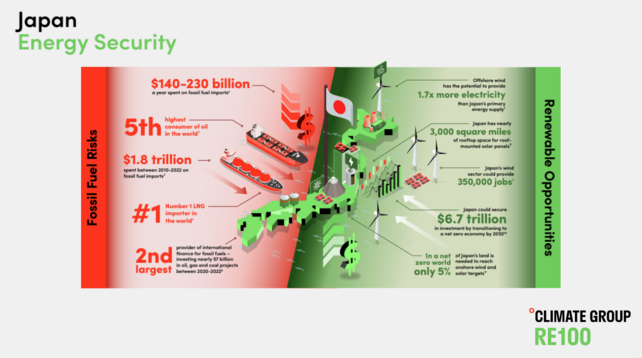
Japan is heavily dependent on imported fossil fuels, spending between US $140-230 billion a year, or between ¥21-34 trillion Japanese Yen, on fossil fuel imports. Between 2010 and 2022, Japan spent 3% of its GDP on fossil fuel imports annually – that’s around USD $1.8 trillion, ¥272 trillion. This reliance on imports is jeopardising not just the energy transition but also Japan’s energy security.
Japan is the world’s number one importer of liquified natural gas. However, according to BloombergNEF, Japan could secure at least US $6.7 trillion in investment by transitioning to a net zero economy by 2050. The country’s current approach risks Japan falling behind in the race to remain competitive in the international marketplace.
Over 200 companies, both headquartered and with offices in Japan, have joined RE100 and committed to using 100% renewable electricity in their operations by 2050. Demonstrating greater ambition on renewables, alongside a supportive policy environment, would help reduce Japan’s dependence on imported energy, increase its energy security and promote direct investment from businesses in the domestic renewables market. To enable this to happen, in June 2024 RE100 launched its six policy recommendations for Japan.
This infographic focuses on Japan’s energy transition and shows the risks associated with fossil fuels and the opportunity of Japan’s renewable electricity future.

Japan Energy Security - English Version.pdf
Size: 806.02 KB
Date added: 05/06/24
Spotlighting Japan's Energy Security - English Version
Click here to learn more about RE100's policy advocacy work in Japan.
Japan committed at COP28 to triple globally installed renewable energy capacity by 2030. It’s actions however are contrary to this pledge as the country has spent over three times more financing fossil fuels internationally than it has on clean energy, nearly $7 billion, or ¥1.5 trillion, a year between 2020 and 2022.
Japan has a huge untapped potential for renewable electricity. Offshore wind has the potential to provide 1.7x more electricity than Japan’s primary energy supply, with the Japan Wind Power Association, estimating that the wind sector alone could provide an additional 350,000 jobs. It’s not just wind power that Japan has an abundance of. Across the country there’s almost 3,000 square miles of rooftop space available for solar panels.
Overhauling a thriving fossil fuel-based economy and switching to renewables is no easy task, but for Japan to improve its energy security and deliver on its commitments, renewables are the only way forward.
More on
EnergyOur latest stories
15 October
Climate Group responds to World Bank–IMF Annual Meetings: Climate finance must deliver for people and communities
06 October
APP joins RE100 and PLN works with Climate Group in major boost to renewables in Indonesia
01 October
"Don’t weaken CO2 standards for trucks”, European businesses urge the EU, as they signal strong demand for electric
30 September
Amorepacific: “Our energy transition is a critical component of our long-term corporate resilience”
23 September
Cambodia, Ethiopia, Ghana, Tanzania, and Uganda join global push for blended cement, bringing government coalition to 12 nations
22 September