
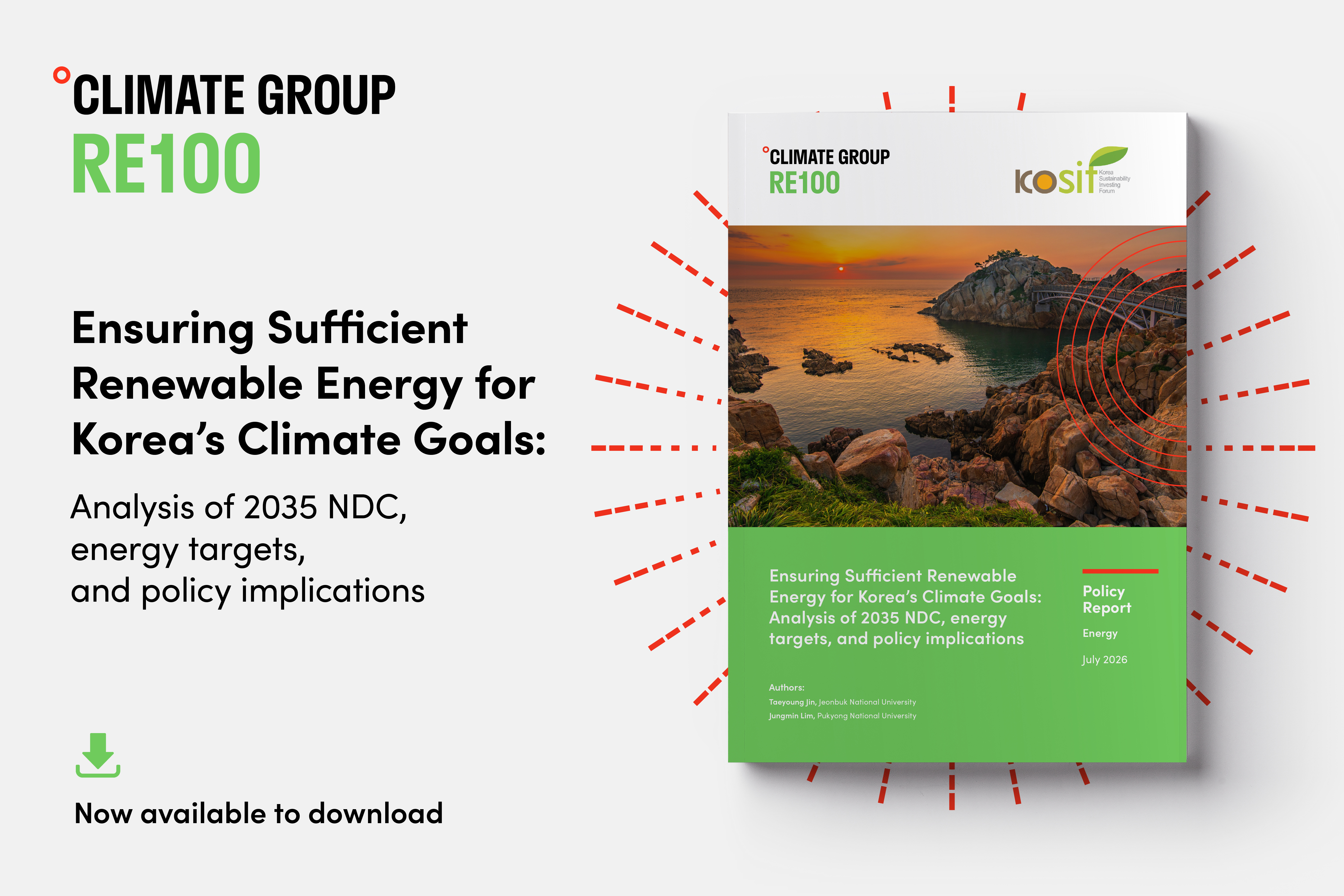

Ensuring Sufficient Renewable Energy for Korea’s Climate Goals

Analysis of 2035 NDC, energy targets, and policy implications

Korea’s current power sector trajectory is not aligned with its 2035 climate targets. While a recent Government announcement of 100GW of installed RE capacity by 2030 significantly raises renewables ambition, it’s essential to accelerate renewable energy deployment to achieve the country's strengthened Nationally Determined Contributions (NDC target of a 53- 61% reduction in greenhouse gas emissions by 2035).


In Korea, a critical policy gap has emerged between the emissions pathway set out in the 11th Basic Plan for Electricity (BPLE) finalised in early 2025, and the more ambitious 2035 NDC submitted in November 2025. This misalignment presents an urgent challenge, the country must accelerate the speed of its power mix transition to meet its near-term climate commitments. Renewable expansion will ultimately be a core determinant of whether Korea achieves its NDC targets.


Key priorities for South Korea include streamlining permitting for solar and wind projects and enabling developers to scale and diversify their business models. Without these interventions, the overall renewable energy supply risks falling significantly short of both corporate demand and national climate ambitions. This paper recommends aligning the 12th BPLE with the 2035 NDC pathway, strengthening governance through transparent stakeholder engagement and closer coordination between central and local governments to support the energy transition, expanding corporate renewable energy procurement through mechanisms such as PPAs and VPPAs, and accelerating the transition to a more distributed energy system. 


Read the full report below. The Korean version of this report is available to download here.


Loading PDF...