

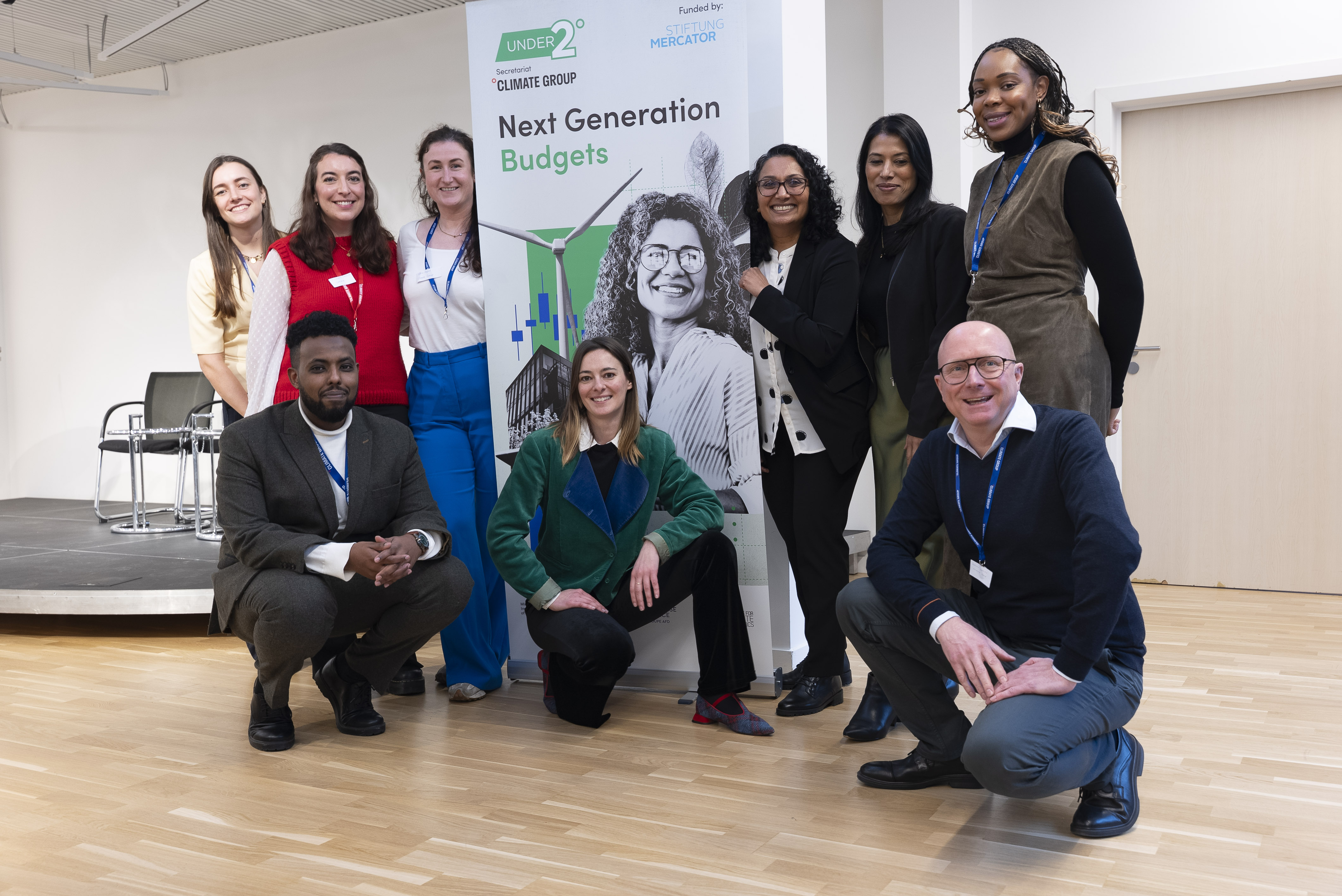
Next Generation Budgets: Two years of transforming public finance for climate action
How states and regions design and deploy their budgets sends a powerful signal about their climate ambition.
Aligned with net zero goals and backed by the right investment frameworks, their budgets can be the tool that bridges policies and impact.
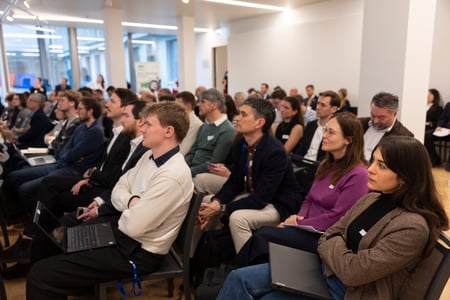
To delve deep into the importance of green budgeting, on 5 February 2026, the Under2 Coalition and the Government of North Rhine-Westphalia co-hosted the final Next Generation Budgets project event in Brussels.
Investing Regions: Green Finance & Budgeting for the Climate Transition brought together over 80 representatives from governments, EU policymakers and financial institutions.
The event marked a moment to take stock of the collective impact of states and regions through green budgeting and innovative ways to attract finance, bringing their net zero emission targets another step closer.
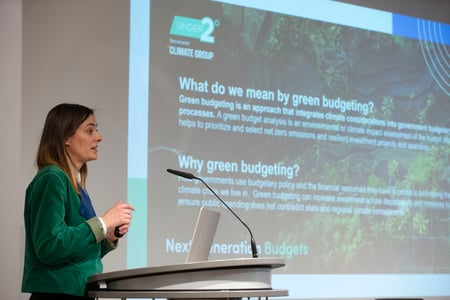
From policy to practice
Over the past two years, Next Generation Budgets has worked with eleven states and regions across Europe and the United States to integrate climate considerations into budgetary processes and drive climate investment. Together, these governments manage an annual budget of over US $420 billion, representing significant greening potential and direct community impact when climate is placed at the centre of spending decisions.
The project has helped governments turn green budgeting from a concept into a practical action-tool. As Carlos Castillo, Project Manager in the Climate Action Department at the Basque Country said at the event:
“We have strengthened cross-departmental collaboration between finance, industry, energy and sustainability departments, and designed a climate budgeting methodology that aligns public spending with climate mitigation and adaptation.”
Throughout the project, a collaborative Community of Practice enabled governments to share insights, learn about recent policies and programs, and increase finance and investment for climate action.
The Governments of Catalonia, North Rhine-Westphalia and Maryland for example, are greening their local economies through climate community funds and green banks. Greening public spending is about building “economic resilience,” explained Charlotte Ruhbaum, Director, Centre for Climate Resilient Society, Stiftung Mercator. “It’s about innovation and long-term competitiveness, and it aligns public spending with future value creation and reduced exposure to structural risks.”
And the Government of North Rhine-Westphalia is putting this into practice. It’s building a resilient economy and communities through its Community Energy Fund. The fund mitigates risks by providing early-phase development funding for community projects that might otherwise struggle with the costs of site surveys, permit applications and legal checks.
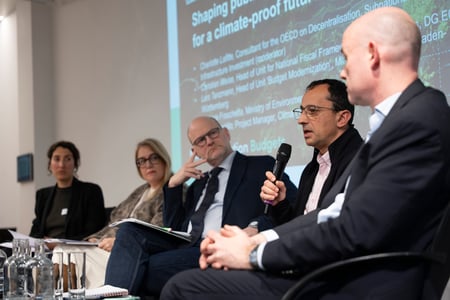
During a panel discussion moderated by Charlotte Lafitte, consultant for the OECD on Decentralisation, Subnational Finance and Infrastructure Investment, regional experts and policy makers exchanged their views about their green budgeting journeys. Lars Tanzmann from the Ministry of Finance, Baden-Württemberg, explained how the Next Generation Budget-project helped shape policies in his government.
“We already had a basic system in place but wanted a more comprehensive picture as its quite a complex task. We connected with other regions through the Next Generation Budgets project.”
Next Generation Budgets provided the technical support to help Baden-Württemberg develop its own green budgeting methodology. The final design is expected this quarter.
Also speaking on the panel was Barbara Fraschetta, representing the Environment Ministry of Lombardy. She highlighted how the project was an accelerator to improve processes.
“We attended all the projects activities and the first thing we did was to establish an interdepartmental working group composed by managers and officials from the Environment and Climate Directorate, Agriculture Directorate and Budget and Finance and Planning Units.” Last year, Moody’s Ratings assigned the government of Lombardy a higher rating level than the national one, including the implementation of green budgeting as a positive element.
Multilevel governance
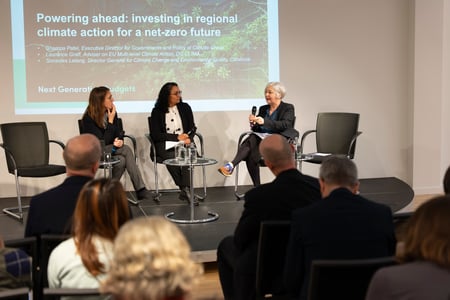
In another panel discussion, Laurence Graff, Adviser on EU Multilevel Climate Action, DG CLIMA, touched on a poignant and timely issue: multilateralism - where it’s lagging, and where it can be strengthened.
During her conversation with Dr Champa Patel, Climate Group’s Executive Director for Governments and Policy, she explained that smooth implementation will require the right cooperation between local, regional and national governments. She called for: “the timely involvement of local, and regional actors to strengthen the existing (EU Climate) framework.”
The EU’s endorsement of the Coalition for High Ambition Multilevel Partnerships (CHAMP) is a strategic step towards multilaterism. Yet steps alone will not deliver the finance required to drive implementation in this decisive decade. Multilevel governance is “central to effective and equitable climate policy”, so how can it be leveraged to ensure that regions across the EU experience the added value of multilevel engagement?
Graff explains, “we’re very happy to join the club and use CHAMP as a new initiative to foster mid-level governance. I see CHAMP as a way to create a space for collaboration among regional actors to share experiences and make it clear that at local level you can make a big difference.”
Can there be a successful pathway to net zero without states and regions, the key economic players? No. States, regional and devolved governments in the Under2 Coalition have proved this. Nearly 73% of its governments are advancing climate action plans, and over 50% of those plans more ambitious than their national counterparts.
In her latest policy brief, Closing the delivery gap, Dr Patel called for a whole-of-government approach and for relationships between national governments and economic actors to be strengthened ahead of COP31.
Ruhbaum also explained why subnational governments matter: “States and regions are where budgetary decision translate into real world outcomes. Initiatives like Next Generation Budgets create the shared language, trust and practical evidence.”
In a rallying cry for more ‘progressive voices’, Graff shared a direct call to subnational governments: “You are the climate doers compared to the climate doomers, you are the implementers.” She continued, “I see a lot of energy, innovation, and promising ideas that you do not necessarily hear from central governments or here in Brussels.”
Climate action in practice: Catalonia’s leadership
In recent years, Catalonia has been a personification of that leadership. It faced devastating extreme weather events, most recently four weeks of rain. Sonsoles Letang, Director General for Climate Change and Environmental Quality, Government of Catalonia, explained how the government is addressing the climate crisis. “We have a strategy for adaptation, and this includes a lot of measures and actions that we are implementing.”
The strategy is supported by a climate fund mobilising €245 million for local projects aimed at reducing emissions and vulnerability.
Anticipating the launch of the new EU Emissions Trading System (ETS) this summer, the discussion turned to how the cap-and-trade scheme, designed to reduce greenhouse gas emissions from industry, transport and aviation, can be better utilised. Speakers noted a significant shortcoming: revenues do not sufficiently reach the level of government at the frontline of climate change. When finance starts and ends at the top, it puts a strain on regional governments.
Dr Patel emphasised the importance of prioritising climate finance as the next step to accelerate implementation: “It’s this level of government (subnationals) that are still able, often with extensive devolved powers, to really put their foot on the accelerator and keep action going. Implementation sits at the city and state level.”
Calling for credible climate delivery
While the two-year project funded by Stiftung Mercator draws to a close, the work continues. This is the year the EU should agree on a budget that will shape European spending until 2034. With cities, states and regions having such a critical role in implementing national policies, cohesive and synergised cooperation among them is paramount.
“As the EU agrees a budget spending to 2034, a 35% climate target is welcome - but delivery is what matters. Shifting to National and Regional Partnership Plans, which centralize funds into single strategies for each Member State, risks weakening regions’ and cities’ direct access to funds, even though that is where the transition happens. Climate credibility requires mandatory green budget analysis, real transparency, and a strong role for subnational governments. Without this, Europe’s transition cannot succeed.” — Jeroen Gerlag, European Regional Director
Looking forward: scaling impact
As Next Generation Budgets closes its two-year journey, one message is unmistakable: climate ambition must be written into every line of the public budget. States and regions have proven that green budgeting is not only feasible; it drives real change, resilience, and innovation.
The challenge now is scale. With the next EU budget cycle on the horizon and climate impacts intensifying, aligning finance with net zero commitments is no longer optional, it is the measure of credibility.
The legacy of Next Generation Budgets extends beyond Europe and the United States: through the pilot Next Generation Help Desk, governments in South Africa and other regions outside the EU and US can access guidance, share practical lessons, and apply the knowledge gained over the past two years showing that the project’s impact will continue long after its formal conclusion.
The takeaway is clear: ambitious policies need bold budgets, at the right level of government. With the right tools, collaboration, and shared learning, states and regions are proving that a net zero future is not just a goal; it’s well within reach.