


Charging the EV transition across Europe – and beyond
When METRO joined EV100 as a founding member in 2017, the international wholesale and food service business had a small number of charging facilities installed at a limited number of locations. METRO made a commitment to add 1,000 charging stations by 2030. It reached its target in 2023, seven years early, and is on track to reach 1,500 next year.
Now the Germany-based company, which has a customer base in more than 30 countries across Europe and Asia, is looking at locations with little EV infrastructure, starting with Pakistan and Kazakhstan.
The average time spent shopping in one of its 600+ wholesale stores is sufficient to recharge an electric car. Based on this simple observation, METRO began its ambitious roll-out of charging facilities – made available to its base of business membership-only customers, as well as to its employees.
Collaboration and a clear internal policy drive success
Success has been driven by the company’s own EV100 initiative – an internal policy that governs the roll-out of charging infrastructure. For every new site, the installation of charging facilities is simply made mandatory; for existing sites, a roadmap is drawn up so that local managers can work on their own roll-out plans with confidence.
The company points to the strong dialogue between its partner charging point operators (CPOs) and distribution system operators (DSOs) as critical to its success, ensuring smooth grid access. Collaboration, in general, has been key.
As a result, the list of countries where all METRO stores are equipped with chargers is growing every year – from Poland, Slovakia and Hungary to Bulgaria, Romania, Moldova, Portugal and Spain. Following the success in countries with minimal EV visibility – METRO has installed chargers in Turkey and Moldova – the company is now looking even further afield. Sites in Lahore, Pakistan and Almaty, Kazakhstan, have the first charging facilities installed – with more to come.
METRO is a committed ambassador for EVs
The group’s Düsseldorf headquarters alone offers almost 100 charging points.
In addition to its active role in rolling out charging across Europe and beyond, METRO sees itself as an ambassador for the EV transition, using its own infrastructure to promote electric mobility. Outside the METRO store in Sofia, Bulgaria, customers are greeted by EVs they can rent to take home their shopping. The cars are provided by a rental company, booked online, and charged at the store.
“METRO was a founding member of the Climate Group’s EV100 initiative in 2017 – at a time when EV charging was just getting started. Our commitment has been an incredible driver to pioneer charging infrastructure and promote e-mobility wherever we operate, and the support we have received from the entire organisation has been even stronger than expected. We are very proud to be an EV100 member.” – Olaf Schulze, Vice President Energy Management, METRO
Pioneering e-trucks in Austria
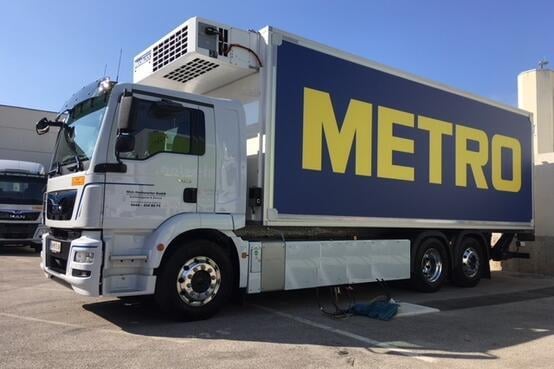
METRO was one of the first companies in Europe to test e-trucks. When major manufacturers such as MAN and Mercedes-Benz launched their first prototypes, in 2018, METRO Austria started running one of just 10 e-trucks licensed in the country, and learnings from the three-year testing phase contributed significantly to the development of e-trucks. A second-generation trial began in 2022.
As a result, METRO Austria is now planning to introduce 15 new e-trucks to its food services distribution fleet; a request for government subsidies has been filed.
An additional challenge for a food delivery company is the need for refrigeration, as this can affect range. In Klagenfurt and Budapest, METRO is experimenting with new solutions, for instance using dry ice technology to keep goods at ideal temperature through transit. Small and large quantities can be carried for up to 24 hours this way, and the system is completely independent of the truck’s cooling.
Meanwhile, food delivery drivers in Germany, where METRO introduced two mid-sized e-trucks in 2024, say they clearly prefer them to the diesel trucks they used to drive.
METRO is a leading international food wholesaler which specialises in serving the needs of hotels, restaurants, and caterers (HoReCa) as well as independent resellers (Traders). It operates in more than 30 countries and employs over 85,000 people worldwide. The group aims to reduce its carbon emissions per square metre of selling and storage space by 50% by 2030. Where possible, electricity for the charging stations will come from solar panels on the roofs of its stores.