

TransportHow can the EV transition become a truly global one? Three key takeaways for a clean transport future from Climate Week NYC
25 October 2024, 15:31 UTC | 2 min read
How can the EV transition become a truly global one?
As this year’s COP29 in Azerbaijan is approaching – with countries taking stock of how to achieve ambitious emission reduction targets – it’s worth reminding ourselves of a sector where those emissions are growing faster than almost anywhere else.
It’s transport – and with almost three quarters of those emissions being caused by road transport, a transition to electric vehicles (EVs) is one of the greatest opportunities we have at driving down emissions. Fast.
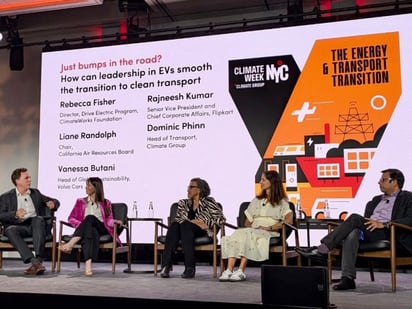
Dominic Phinn, our Head of Transport, was at Climate Week NYC to discuss the clean transport future with business and government leaders. How can strong policies speed up the EV transition in emerging economies? And how can our electrical grids meet the rising demand for electric vehicles?
Here are three things Dominic took away from the inspiring sessions in New York:
1.
Companies are leading the way on the EV transition – but without strong, supportive policies, progress will remain uneven.
Reliable regulatory frameworks, especially supply side regulation and mandates, strong financial support, and strategic infrastructure investments in emerging markets are key requirements for the EV transition to pick up the necessary speed.
“Volvo is committed to fully electric cars. We don’t invest in internal combustion engine vehicles anymore. We welcome regulation because it helps us with the transition.”
Vanessa Butani, Head of Global Sustainability, Volvo Cars
2.
To drive the EV transition forward, collaboration and exchange are crucial.
Companies understand that they can’t do it alone. With so many different elements coming together – charging infrastructure, grid supply, EV availability – EV adopters need to find new ways of working together.
“Our job is to work within an ecosystem. We design and deploy infrastructure in partnership with manufacturers of chargers and vehicles.”
Rajneesh Kumar, Senior Vice President and Chief Corporate Affairs, Flipkart
3.
We need to go faster – everywhere.
As emerging economies are shifting gear, advanced EV markets can’t take their foot of the pedal. It's now up to stakeholders across the board to ensure this transition can be delivered with the speed and ambition necessary to realise the full benefits of electrified road transport.
“It is time for a truly global transition. But there’s still this bifurcation in the market, with EVs available in some markets, and not others. Any technology transition is going to have bumps on the road, but they’re not insurmountable.”
Rebecca Fisher, Director, Drive Electric Program, ClimateWorks Foundation