


RE100 member Amorepacific, South Korea's largest beauty and health company, reached 100% renewable electricity in just over five years. Sunchul Kwon, Head of Safety & Environment Division, tells us how they got there – and why companies that have made the transition have a responsibility to help others follow.
Amorepacific's company-wide renewable electricity transition stood at just 5% in 2020. What were the key factors in reaching your 100% goal in just 5 years?
After joining RE100 in 2021, we began driving voluntary energy efficiency improvements and proactively developed a diversified renewable energy procurement portfolio. Those were two key factors in achieving 100% fast.
Before procuring renewable electricity externally, we focused on reducing our electricity demand across our operations. Recent technical upgrades include replacing localised LNG-based heating systems with a highly efficient, centralised electric heating system, further improving energy efficiency and supporting our decarbonisation efforts. This was formally recognised when our Daejeon Hair & Beauty manufacturing site was selected as an Outstanding Workplace under the Voluntary Energy Efficiency Target System organized by the Korea Energy Agency in 2025.
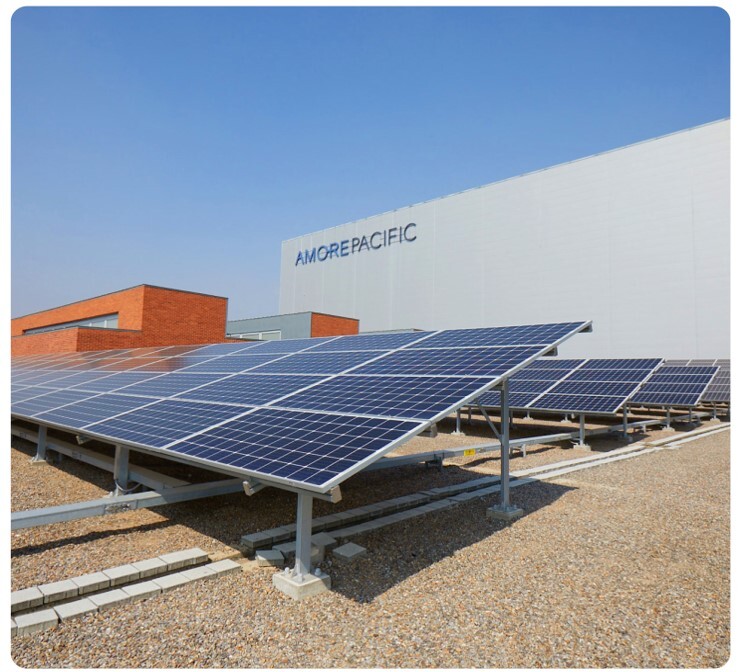
Our multi-layered procurement strategy avoids reliance on any single renewable energy sourcing mechanism, to diversify risk. We expanded our self-generation capacity from 0.2MW in 2011 to around 7.1MW today, and we combined a range of renewable electricity procurement options available in South Korea, including different forms of PPAs, REC purchases, and the Green Premium programme.
As a result, our renewable electricity rate increased steadily from 5% in 2020 to 19%, 34%, 51%, and 70% in subsequent years, ultimately reaching 100% across all our operations in 2025. Through this phased and carefully optimised approach, we were able to achieve our original 2030 target five years ahead of schedule.
You've said that renewables are rooted in your company's "strategy for future corporate survival." Why are they so important to you?
For us, the transition to renewable electricity goes far beyond environmental responsibility. From both a risk management and business perspective, it’s become a critical component of long-term corporate resilience, and future growth.
Renewable electricity is essential to achieving our net zero ambitions, of course. As companies work toward a net-zero future, renewable energy is a fundamental requirement.
But what’s more: renewable energy investments help protect businesses from energy price volatility and external market shocks. When geopolitical tensions contributed to significant increases in industrial electricity prices in South Korea, our energy costs were also affected. But the electricity secured through our on-site renewable generation assets and long-term power purchase agreements (PPAs) remained largely insulated from those price increases, helping to cushion the financial impact.
This experience reinforced the value of renewable energy not only as a sustainability solution, but also as a risk management tool. By securing a portion of our electricity supply through long-term, fixed-price renewable energy contracts, we’ve improved cost predictability and strengthened our resilience against future energy market fluctuations.
Finally, reducing the carbon footprint of products is becoming both a regulatory expectation and a key source of competitive advantage in global markets. Consumers, investors, and regulators are increasingly demanding greater transparency and lower emissions throughout product value chains. Transitioning to renewable electricity will be an important strategic asset in strengthening the global competitiveness of K-Beauty products in the years ahead.
How are you working with partners to achieve your sustainability goals and why is this important?
Achieving our sustainability goals requires collaboration across the entire ecosystem. We work closely with policymakers and public institutions, for instance. As one of the first companies in South Korea to implement both direct PPAs and VPPAs, we have actively shared practical insights with the Ministry of Trade, Industry and Energy, Korea Electric Power Corporation (KEPCO), and the Korea Energy Agency on topics such as settlement mechanisms, grid charges, VAT treatment, and renewable energy certificate (REC) frameworks.

Another key collaboration is with local communities. Take our VPPA agreement with a community-owned wind farm in Jeju. Under the contract's fixed-price settlement structure, when wholesale electricity market prices (SMP) fall, we compensate for the resulting revenue shortfall, helping the community-operated renewable energy project maintain stable income. We believe this model is significant because it goes beyond simple electricity procurement. It enables buyers and renewable energy producers to share market risks and benefits together.
We also work closely with suppliers to advance decarbonisation throughout our value chain, because we believe meaningful climate progress depends on building capabilities and reducing emissions together with our business partners, rather than acting alone.
Ultimately, the transition to renewable energy cannot be achieved by any single company in isolation. It requires collaboration among businesses, policymakers, local communities, and supply chain partners. By working together, we can create an ecosystem that accelerates both corporate decarbonisation and the broader growth of renewable energy.
You've described achieving RE100 as "not an end but a new starting point". What's next?
Achieving 100% renewable electricity across our operations is a milestone we are incredibly proud of, but we see it as the beginning of our next chapter, rather than the end of our journey.
Our focus now is on increasing the share of renewable electricity sourced through procurement mechanisms that deliver greater additionality. In particular, we aim to expand the role of direct PPAs and VPPAs, which enable the development of new renewable energy projects and contribute to the growth of renewable energy capacity beyond our own operations.
At the same time, we recognise that emissions from our own facilities represent only a portion of our overall carbon footprint. Our next challenge is to expand our climate action beyond operational emissions and work with suppliers to accelerate emissions reductions across our value chain. Advancing progress in Scope 3 emissions will be a key priority for us in the years ahead.
Companies that have successfully navigated the renewable energy transition have a responsibility to help others move forward. As South Korea's renewable energy market evolves, we want to share the experience and expertise we have gained with policymakers, with RE100 industry councils, and with other companies seeking to expand their use of renewable electricity.
Sunchul Kwon is Head of Safety & Environment Division at Amorepacific.