

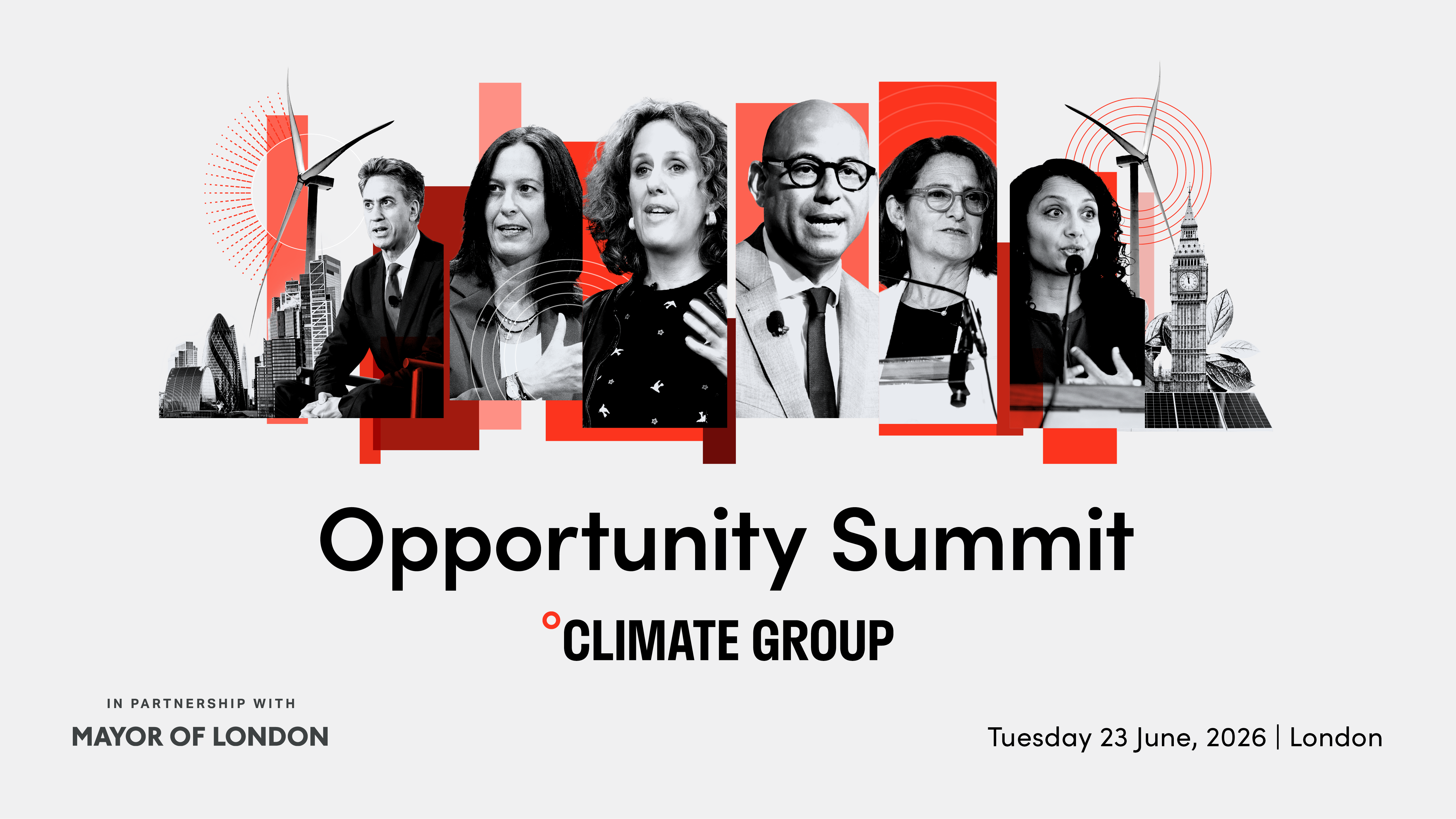
With Climate Group’s Opportunity Summit fast approaching… this is London calling.
We’re looking ahead to London Climate Action Week in June, giving some our summit speakers a call to hear their thoughts on how the energy transition is reshaping opportunity across London, the UK and Europe.
Serish Gandikota of the University of Cambridge’s Frugal AI Hub explains how frugal AI could define Europe’s competitive edge. Described on his organisation’s website as “doing more with less across compute, energy, data, and capital,” here are five key takeaways from our conversation.
Hear more from Mr Gandikota at the Opportunity Summit on 23 June 2026.
Frugal AI goes beyond cutting costs and energy
“When people think about the word frugal it's misunderstood as simply doing things cheaply but it's not about that, it's broader than that, it's about what kind of AI model fit you have for your use case.” Serish Gandikota
Frugal AI is about designing systems that match real needs, existing infrastructure, and your resources, says Mr Gandikota. That means delivering better outcomes or achieving organisational goals with less waste. By reflecting existing needs, AI can operate in line with Europe’s net zero ambitions.
2. AI can’t just focus on increasing capability
“The more important question now is whether organisations can actually absorb what AI can do.” Serish Gandikota
The opportunity for Europe lies in real-world deployability, trust, and resilience, ensuring AI systems work reliably at scale. AI’s capability has been consistently growing, but now it’s important to focus on embedding AI into society more sustainably.
3. Finding competitive advantage in constraint
“[Constraints] are often framed as disadvantages… but I actually think they are forcing exactly the kind of discipline that produces better AI systems.” Serish Gandikota
Energy and grid constraints are an opportunity for Europe to push innovation toward more ‘frugal’ systems that are more efficient, scalable and sustainable from the outset. Mr Gandikota explains frugal AI as using smaller, more task-specific models, and running them closer to where the data is generated, for example, on people’s devices or on more local infrastructure. By reducing the need for large-scale compute and constant data transfer, these systems deliver strong, more efficient performance while using far fewer resources.
4. Frugal AI can make AI more accessible and sustainable
“Already taking those [constrains] into consideration from the very beginning … you are building much more robust and scalable solutions.” Serish Gandikota
By lowering compute and infrastructure requirements, frugal AI opens the door to wider adoption that goes beyond just large tech players. This gives public services, smaller businesses, NGOs and underserved communities the opportunity to benefit from AI, which leads to a more inclusive and equitable digital transition.
5. And frugal AI can quickly drive further optimisation
“Not everything needs to be built from scratch we don't need to in most cases reinvent the wheel… the biggest opportunity is where AI helps optimise what already exists.” Serish Gandikota
From the electricity grid to hospitals and supply chains, choosing frugal AI can quickly optimise existing ways of working. It can unlock significant efficiencies across the economy and drive competitive advantage by improving the systems we already rely on today, such as the energy system, all without the need for resource-intensive solutions.