

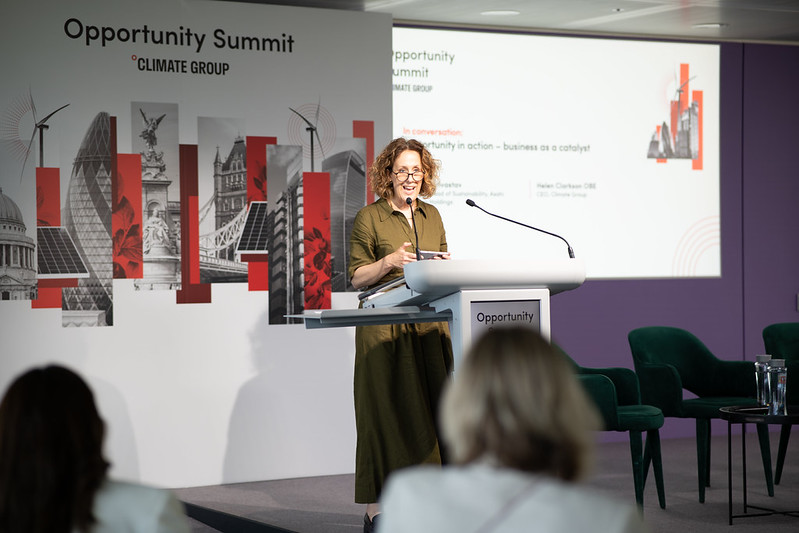
A heatwave, a wake-up call, and a week of action
The relevance of London Climate Action Week (LCAW) taking place during a record-breaking heatwave was not lost on anyone. For those of us gathered in the city, the sweltering temperatures were less a backdrop and more a blunt reminder of exactly why these conversations matter.
Our CEO Helen Clarkson put it plainly on BBC News: "Air conditioning makes cities hotter because it pushes all the hot air outside, so it's not an obvious solution to people here. We need deeper structural change, which is about weaning our economies off fossil fuels, electrifying everything, and moving into the new future we know we should have to stop this rise continuing."
This urgent, solutions-focused lens defined Climate Group's presence across LCAW 2026. From our inaugural Opportunity Summit to the panels, roundtables, and forums our team hosted, participated in, and attended across the city, one theme emerged above all others: the clean energy transition is no longer just a moral imperative. It is an enormous economic opportunity – and the time to seize it is now.
Wide media coverage included Reuters, Reuters Finance Live, Sustainability Mag, and Energy Digital.
The Opportunity Summit: Europe's clean energy moment
The centrepiece of our London Climate Action Week activity was the launch of our flagship event, the Opportunity Summit, which brought together senior leaders from business, government and civil society to chart new pathways for Europe's clean energy competitiveness. Across workshops, panels and keynotes, the message was consistent: climate and economic goals are deeply, and increasingly, intertwined.
The tone was set in the opening leadership dialogue between Helen Clarkson and Anthony Agotha, Special Representative for Climate and Environment at the European Union: “Science impels us. The economy literally beckons us; there’s a lot of money to be earned. Health and security dictate us… if the market internalises this transition, there’s no stopping that.”
The Summit also marked the launch of our 24/7 Carbon-Free Coalition, calling on organisations to commit to hourly, not just annual, carbon-free electricity matching (see media coverage). Rianne Buter, Global Head of Sustainability at Unilever, was among the first to join: "Progress is happening, but it needs to accelerate. And to do that, we need many more organisations to explore the scaling up of 24/7 carbon-free electricity.”
Catch up on the event livestreams.
From methane to net zero airports: Climate Group's London Climate Action Week events
Beyond the Summit, our team hosted a series of focused sessions across the week. At our Smart Energy event, speakers from the Green Finance Institute, Siemens, and CLASP challenged corporate attendees to take three concrete actions in the next 90 days to accelerate energy efficiency investment.
Our Pollutants to Prosperity event, hosted with Subnational Methane Action Coalition (SMAC) and Climate and Clean Air Coalition (CCAC), tackled the gap between national methane commitments and subnational delivery. And in partnership with Concrete Zero and Corgan, we convened a roundtable on net zero whole life carbon in UK airports, bringing together cross-sector stakeholders to share barriers, solutions, and best practice. Here, Net zero whole life carbon refers to a building's total emissions - from construction through to demolition - adding up to zero.
We also hosted Start, Stop, Scale – a climate disinformation workshop in partnership with Regions4, bringing together subnational leaders, journalists, communications experts, and policymakers to ask a question that felt especially urgent against the backdrop of record heat: how do governments build trust in an era of misinformation? Moderated by Reuters Energy Editor Sharon Kits Kimathi, the session drew on real-world examples: from Rio's 2024 floods met with denial, to California wildfires where tackling disinformation directly helped save lives.
The conclusion was sobering. As climate risks intensify, so does the challenge of navigating a global information landscape where AI is scaling disinformation faster than newsrooms can report. Subnational governments are increasingly on the frontline of both.
Climate Group team takes on the city (and the heat)
Despite the challenging conditions, our team was active across London all week, and the insights they brought back will shape our work in the months ahead.
-
Helen Clarkson, CEO, moderated a session at the Climate Innovation Forum on why climate action makes business sense, in conversation with Chief Sustainability Officers from Volvo Group, Vale, DOW and South Pole.
- Champa Patel, Executive Director of Governments & Policy, attended a special address by UN Secretary-General António Guterres, who reminded us: "The renewables revolution is well underway. A revolution of clean power, electrification, falling costs, rising ambition – and vast opportunity."
- Rik Goverde, Director of Programme and Corporate Communications, heard from EU Special Envoy Tony Agotha and former US Secretary of State John Kerry at a high-level convening on fixing climate communications.
- Elsewhere, Dominic Phinn, Head of Transport, chaired a panel on zero-emission transport, where the key message was clear: the technology is ready, but what's needed now is policy stability, grid investment, and a sharper focus on selling EVs on performance and cost, not just climate.
- Nia Bell, Senior Manager, Concrete, joined the conversation on decarbonising concrete, where the verdict was that solutions exist, but data silos and slow adoption of low-carbon materials are holding the sector back.
- Monica Mata, Senior Manager, Latin America, represented Climate Group at a London School of Economics dialogue on Latin America's energy transition – important ground for advancing RE100's policy work in the region.
Key takeaways and what comes next
If LCAW 2026 had a single defining message, it was this: the opportunity is real, enormous, and here right now. While the conversations were many, here are a few notable threads:
-
The language has shifted from burden to a competitive new energy future.
- The technology exists, but the bottleneck is now deployment, finance, and policy stability.
- National commitments need subnational delivery since cities, regions, and corporations are where the action happens.
- We need to communicate better. Climate coverage dropped 12% between 2024 and 2025. The sector must connect climate to what people care about, whether that’s sports, health, jobs, or nature.
The week reminded us that urgency hasn't diminished. The momentum is real, the solutions are ready, and the opportunity is knocking.
Next up: Climate Week NYC in September. We'll see you there.